Canva Daily Journal Template11: Your Blueprint for a Profitable Print Business
In the crowded market of digital products, standing out requires more than just a good idea; it demands a unique execution. The Canva Daily Journal Template11 is not your average, cookie-cutter planner downloaded straight from a generic library. This is a carefully curated design system where the majority of the illustrations, background textures, and visual elements are custom-created. For print business owners, this exclusivity is your biggest asset. It ensures that the final product you sell won't look identical to a thousand other journals floating around Etsy or Amazon KDP. Instead, you are offering a sophisticated, proprietary aesthetic that feels premium and intentional.
The core appeal of this template lies in its balance between aesthetic beauty and functional psychology. It is designed to be a premium font and layout experience that guides the user through a holistic daily routine. It isn't just about listing tasks; it is about mindset. The structure encourages users to record their hopes and dreams alongside their grocery lists, creating a deeper emotional connection with the product. For the creative entrepreneur, this template serves as a robust foundation. You aren't starting from a blank canvas; you are refining a professional design asset that already possesses a strong visual hierarchy and a clear personality.
Defining the Visual Personality and Style
When you open the Canva Daily Journal Template11, the immediate impression is one of curated elegance mixed with approachable warmth. Because the illustrations and photos are sourced outside of the standard Canva library, the style avoids the "stock photo" fatigue that plagues many digital products. The visual language feels distinct, likely utilizing a blend of modern typography and organic design elements. This creates a vibe that is both professional and deeply personal—perfect for the self-development and productivity niche.
From a typography perspective, the template leverages a smart mix of font styles to create visual hierarchy. You will likely see a pairing of a clean sans serif font for the instructional text and prompts, ensuring maximum readability, alongside a more expressive script font or handwritten font for headers. This contrast is crucial. It signals to the user where to focus their attention. The handwritten elements add a layer of intimacy, suggesting that this journal is a conversation between the user and their future self, rather than a cold corporate form. This combination of typefaces is a masterclass in modern typography, balancing legibility with emotional resonance.
Structuring the User Experience: The Three-Page Flow
The genius of the Canva Daily Journal Template11 is in its simplicity. It condenses the journaling experience into three impactful pages, making it accessible even for those who feel intimidated by blank pages.
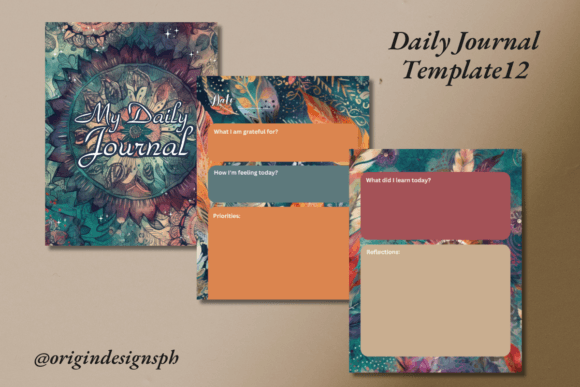
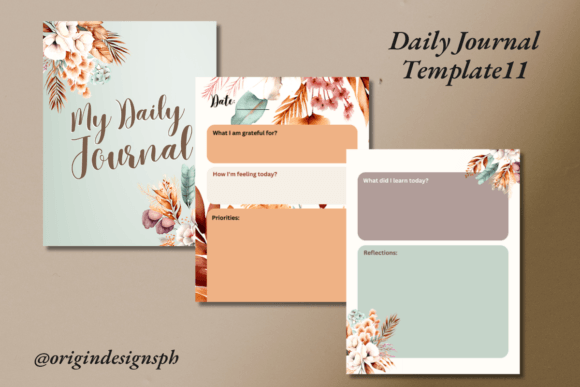
Page 1: The Journal Cover
This is your first impression. The cover design sets the tone for the entire brand identity. Because the background elements are unique, you have a strong foundation to build a brand around. Whether you are selling this as a standalone PDF, a printed spiral-bound book, or a digital GoodNotes file, the cover needs to scream quality. This is where you can customize the layout to include your client's name or your own branding, turning a generic template into a personalized logo design showcase.
Page 2: The Morning Mindset
This page focuses on "What I am grateful for?", "How I'm feeling today?", and "Priorities". From a design standpoint, this layout forces a clean separation of thoughts. It prevents the user from feeling overwhelmed. For your print business, this structure is a selling point. You are selling clarity. The layout should be airy, using whitespace effectively to let the user’s handwriting breathe. This is not a dense spreadsheet; it is a space for reflection.
Page 3: The Evening Reflection
With sections for "What did I learn today?" and "Reflections," this page closes the loop. It encourages growth. Visually, this page often mirrors the structure of Page 2 but with a slightly different tone, perhaps using softer colors or different accent illustrations to signal a transition from the active day to the winding down evening.
Strategic Applications for Print and Digital Businesses
If you are looking to take your print business to the next level, the versatility of the Canva Daily Journal Template11 is its strongest feature. The prompt mentions it is designed to help customers stay on top of priorities, but as a business owner, you need to think about how to package this utility.
Expanding Beyond the PDF
While the template comes as a file you can "easily edit, print, and send," don't limit yourself to just digital downloads. The 8.5 x 11 inch size is the industry standard for printing. Consider offering a "Print-Ready" version as a premium upsell. Because the design elements are high-quality and unique, the journal translates beautifully to physical media. You can market this as a packaging design opportunity—bundle the journal with a pen or a planner cover to create a physical gift set.
Brand Consistency and Recognition
Using the Canva Daily Journal Template11 allows you to maintain brand consistency across your product line. If you are a content creator or blogger, you can adapt the visual style of this journal for your social media graphics. Use the same color palette and font pairings found in the template for your Instagram Stories or Pinterest pins. This creates a cohesive ecosystem. When a customer sees your journal, they should instantly recognize it as part of your broader brand identity. This consistency builds trust and professionalism, signaling that you are a serious player in the creative font and design space.
Customization for Niche Markets
The beauty of the Canva editor is that you don't need a Canva Pro account to make basic edits, though Pro helps with resizing. However, the real value you add is niche targeting. Use the template as a base, but swap out the prompts for specific audiences.
- Fitness Niche: Change "Priorities" to "Workout Plan" and "Reflections" to "Calorie Check."
- Creative Niche: Change "What did I learn?" to "Inspiration Sources" and "Priorities" to "Sketches/Drafts."
- Business Niche: Focus "Priorities" on "Revenue Generating Activities" and "Reflections" on "Client Feedback."
Practical Guidance for Designers and Sellers
To maximize the potential of this asset, you need to approach the editing process with a strategist's eye. It is not enough to simply change the title and upload the file.
Evaluating Project Fit and Font Pairings
Before you start selling, look at the existing font pairing in the template. Does it match your store's vibe? If you run a rustic, farmhouse-style shop, a sleek, futuristic sans-serif might clash. You may need to swap the fonts. Canva offers a vast library, but ensure you choose a commercial font or a font that is free for commercial use if you plan to sell the end product. Look for a serif font if you want a more traditional, academic feel, or stick with the handwritten font for a casual, friendly tone.
When testing readability, print a sample page. Editorial design isn't just about how it looks on screen; it's about how ink interacts with paper. Are the lines spaced enough for handwriting? Is the prompt text too small? The Canva Daily Journal Template11 is generally well-spaced, but always verify that your customizations haven't cluttered the layout.
Leveraging the "Unique Design" Advantage
Remember the key selling point: the illustrations are not from the standard library. This is a massive advantage for web design and packaging design. It means your product won't look like a template. When you market this journal, highlight the exclusivity. Use phrases like "Custom Illustrated" or "Bespoke Design" in your product descriptions. This elevates the perceived value, allowing you to charge a premium price.
Furthermore, consider the commercial font licensing. While Canva allows you to use elements within the platform, always double-check the license if you are downloading the design to sell as a static PDF or physical print. The goal is to create a sustainable business asset, not a copyright headache.
Finalizing Your Product
The Canva Daily Journal Template11 provides the structure: the cover, the gratitude, the priorities, and the reflections. Your job is to inject the soul. Use the space to write for "What I am grateful for?" but ensure the font style invites the user to actually write. A display font might look cool for the title, but if it's too complex, it ruins the user experience.
Ultimately, this template is a tool for connection. It helps your customers organize their chaos and articulate their dreams. By leveraging its unique visual assets and thoughtful structure, you aren't just selling a PDF; you are selling a daily ritual. Whether you are a designer looking for a quick turnaround project or an entrepreneur building a stationery empire, this template offers the perfect blend of style, substance, and scalability. Edit it, brand it, print it, and watch your business grow.
Canva Daily Journal Template11: A Designer's Guide to Selling Unique Planners
In the saturated market of digital planners and printables, the difference between a product that converts and one that gets lost often comes down to uniqueness. The Canva Daily Journal Template11 isn't just another layout; it's a strategic design asset. What sets this specific template apart is its visual identity. Unlike many generic resources where users spot the same recycled stock photos, this template features custom illustrations and backgrounds. For the creative entrepreneur, this means you aren't selling a "template"—you are selling a proprietary aesthetic. It offers a distinct personality that feels curated and high-end, giving your print business an immediate edge in brand identity.
Visual Hierarchy and the "Gratitude" Flow
As a designer or publisher, you understand that a journal is more than just lined paper. It is a tool for behavioral change. Canva Daily Journal Template11 excels because it utilizes strong visual hierarchy to guide the user through a specific psychological journey. The layout is segmented logically: "What I am grateful for?", "How I'm feeling today?", and "Priorities."
This structure isn't arbitrary; it is a design choice that influences user engagement. By placing gratitude and emotion at the top of the page, the template encourages a mindset shift before the user tackles their to-do list. From a typography standpoint, this requires a delicate balance. The headers likely use a handwritten font or a script font to evoke intimacy and personal reflection. In contrast, the instructional text relies on a clean sans serif font or serif font to ensure the prompts remain legible and unobtrusive. This font pairing is critical. It creates a rhythm on the page that feels organic rather than clinical, which is essential for personal stationery.
The Power of the "Reflection" Page
The third page of the template focuses on "What did I learn today?" and "Reflections." For those in the editorial design or content creation space, you know that endings matter. A journal that abruptly stops after the to-do list feels transactional. A journal that asks for reflections feels transformative.
Design-wise, this section often allows for more open whitespace. This negative space is a design asset in itself. It signals to the user that there are no wrong answers here. When you are customizing this for your customers, pay attention to the line weight and spacing. If you are adapting this for web design (like a digital PDF for tablets), you might want to increase the interactive area. If it is for packaging design and print, ensure the margins are wide enough so that handwriting doesn't get lost in the gutter of the binding.
Strategic Customization for Your Niche
One of the most compelling features of Canva Daily Journal Template11 is the ease of editing. The prompt explicitly states you do not need a Canva Pro account to make changes. This accessibility is a massive win for small business owners. However, "easy to edit" shouldn't mean "easy to make generic." Your goal is to leverage the unique illustrations to build a brand identity.
Tailoring the Aesthetic
Because the illustrations are